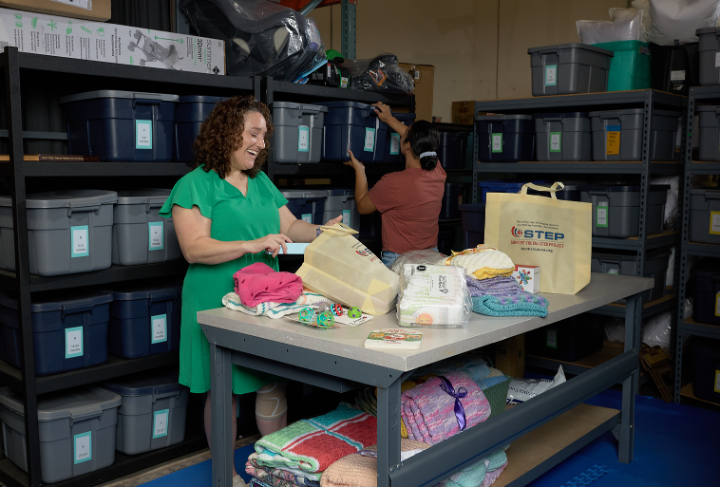
When Rena Rhine was serving in the Navy and raising two children as a single mother, she knew what it meant to stretch every dollar.
Today, Rhine is a senior client services supervisor at Support The Enlisted Project (STEP), a nonprofit that helps service members and military families build financial stability. Her understanding of the pressures these families face came from her own experience in uniform.
Rhine joined the Navy at 17 and spent eight years with the Naval Construction Force as a Seabee, helping build and maintain infrastructure for military operations. As a junior enlisted sailor, she faced an unreliable car, unexpected expenses and periods when affording food for her family was difficult.
“It wasn’t that I was doing ridiculous things with my finances,” Rhine said. “All of these little things compounded.”
Her experience reflects the financial pressures many military families continue to face today. According to Blue Star Families, 38% of active-duty military families said they were “just getting by” or “finding it difficult to get by.”
For military families, a Permanent Change of Station (PCS) — the routine relocation that comes with a new assignment — can strain a budget overnight. When orders take a family to a high-cost area, housing alone can consume a large share of their budget — particularly in markets like San Diego, where many of Rhine’s clients live and 58% of renters are cost-burdened, according to the San Diego Regional EDC. A spouse may have to restart a career after a move or weigh the cost of child care against going back to work. On top of that, a move brings expenses that are easy to overlook — restocking a refrigerator, replacing household items left behind. A report by The USAA Educational Foundation found that nearly one in four military-connected households has less than $500 in emergency savings — and for those families, a small financial setback can quickly become a larger crisis.

A new way to serve
Her path to social work, though, began while she was still in uniform.
During her divorce and other difficult experiences while in the military, Rhine connected with a licensed clinical social worker.
“She really changed my life,” Rhine said. “It opened my eyes to the fact that there is a way to help people.”
By the time Rhine left the Navy in 2011, she knew she wanted to pursue social work and remain connected to the military community. After earning her bachelor’s and master’s degrees in social work, she came across STEP during her job search in 2020 and discovered an area of social work she had not encountered before: financial social work. The work appealed to her for a reason she understood personally.
More than knowing what to do
“It’s not always a lack of knowledge,” Rhine said. “It’s a disconnect between skills and behaviors to apply that knowledge.”
That’s what makes STEP’s approach different. Its financial counselors are also credentialed social workers, all with firsthand military experience, who work one-on-one with each family for 20 to 30 hours. Services are free, and emergency financial support is provided as grants paid directly to vendors — not loans families have to repay.
Support continues for a full year after the crisis, with regular check-ins to keep families on track. The approach has shown results: STEP has served more than 11,000 families nationally with a 90% effectiveness rate in preventing homelessness, food insecurity and other losses of basic needs. Only 3% of families who receive emergency grants return for additional help.

Expanding a proven model
With Honor Through Action, USAA plans to invest $5 million over five years to help STEP expand its Financial Wellness Counseling model nationally, with the goal of reaching 5,000 military families.
The funding will help STEP hire additional social workers, strengthen technology and referral systems, build partnerships with military and veteran-serving organizations, and expand access to counseling and emergency assistance. The next expansion phase includes Arizona, New Mexico and Texas, building on STEP’s work in California, Hawaii, Oregon and Washington.
STEP also plans to incorporate free financial education resources from The USAA Educational Foundation, giving families additional guidance on budgeting, saving, credit and debt management, major purchases and other financial decisions.
Turning a crisis into a plan
That long-term focus is something Rhine sees in every family she works with — including a recent STEP client, a dual-military family whose financial situation changed dramatically when one spouse was medically discharged from the military.
Almost overnight, a household built around two incomes was relying on one. The family called STEP in tears, unsure how they would cover their most basic expenses.
Rhine and the family developed a plan together and stayed in close contact — weekly at first, then less frequently as the family gained footing.
Within about six months, the family was cash-flow positive.
But their work together did not stop there. Over the next few years, the goals changed. First, it was paying the bills. Then it was building savings. Eventually, the family began planning to buy a home.
Rhine remembers the contrast with that first conversation, when the client had called in tears. Later, the client told her: “I’ve got bigger goals.”
Hopes and dreams
Today, Rhine and her colleagues can be there for families facing the same financial pressures she once did.
The client who called in tears is now planning for a home of her own — a transformation Rhine calls the whole point of the work.
“We all have hopes and dreams that you hold close inside, but until they’re spoken and a plan is made, they’re just hopes and dreams,” Rhine said. “We’re working to take those hopes and dreams and turn them into a reality for our clients.”